Jan 2013
Palm Springs & the High Desert: It's a Dry Heat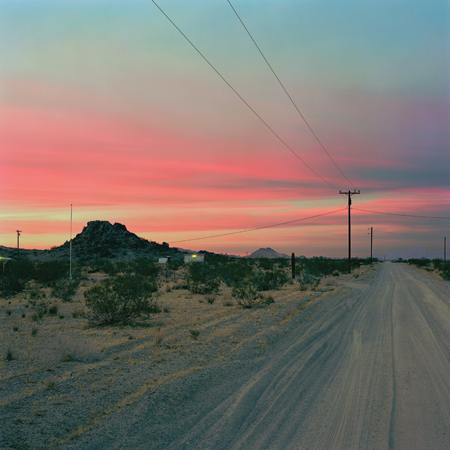
N34 12.328'W116 01.391B
(from the series, "Isolated Houses," 1995-98)
John Divola
Archival Inkjet print
19" x 19"
Photo: copyright: John Divola, courtesy Gallery Luisotti, Santa Monica
Stefanie
Schneider calls out for Lucy, one of her cats, who followed her outside
her Morongo Valley house, down a hill to her studio (a shipping
container with a room addition and a patio) and around the 2.5-acre
property on a dirt road where she docks several trailer homes in varying
states of condition--from disrepair to comfy, authentic Americana guest
quarters. The 1950s trailer with the white picket fence was the
backdrop of a series of photographs Schneider shot on expired Polaroid
stock and parlayed into a feature film that screened at Light Assembly
Miami Beach, held in early December during the Miami art fairs.
"I
dreamt of this for so long," she says, gazing into the vast High
Desert. "You can't do this in Los Angeles. You can't afford this kind of
life anyplace else. Here, you buy your freedom."
She seems to
have all the space in the world, but she's hardly alone. The area, and
particularly Joshua Tree, has gained a greater profile since Andrea
Zittel launched A-Z West ("An Institute for Investigative Living") and
High Desert Test Sites here more than a decade ago. But in fact, artists
have sought the desert's wide-open expanses for almost 150 years.
If
the High Desert--which also includes Twentynine Palms and Wonder
Valley--looks exotic today, it might as well have been the surface of
Mars in the 1870s, when the Southern Pacific laid rails near Palm
Springs and ushered in illustrators who would depict the desert in
drawings used to entice others to travel to the area. By the 1920s,
American and European Impressionist painters who had plied their trade
on the East Coast would discover fresh sources of inspiration, a
healthier climate and a freedom that shaped a regional style reflective
of the distinctive light and shadows on the desert landscape.
"Of
all the regional schools [of Impressionism], California--especially
Southern California--was richest in quality artists and works," says
William H. Gerdts, professor of art history at the Graduate School of
City University of New York. "The earlier painters back in the Northeast
usually chose intimate landscapes--often their own home
environment--rather than the expansive landscapes of the West Coast. And
then there is a difference in the light of Northern France, the light
of New England, and the light of Southern California, which affects the
work of the landscape painters."
The French Impressionist John
Frost, the subject of a forthcoming book from the Irvine Museum, was one
of the first to come to Palm Springs, according to Thom Gianetto of
Edenhurst Gallery in Laguna Beach. "Frost was determined to find French
beauty in the dry, arid no man's land," he says. Other significant early
artists who painted from Palm Springs to Indian Wells to the Salton Sea
included Alson Skinner Clark, Charles Fries, Jimmy Swinnerton and Paul
Grimm, who painted Hollywood movie sets before building his desert ranch
house in 1935.
By the time the High and Low deserts came into
their own as subjects for artists, modernism had begun to eclipse
impressionism as the favored style of the day. One artist who adapted
with great success was Agnes Pelton, of Cathedral City, who turned from
classic landscapes to transcendental modernist paintings.
Today,
the desert holds the same surface appeal it did 100 years ago, but it
also has become a place to study, experiment and reflect. It should come
as no surprise that the Santa Barbara-based University of California
Institute for Research in the Arts and UC Riverside have created a
immersion experience for the UC system's MFA candidates, who propose and
turn out smart, site-specific works about the desert's natural, social
and cultural landscapes.
High Desert: Broken Dreams, New Promises
The
spirit of freedom that drew early painters to the desert continues to
attract artists from Los Angeles to Europe. Zittel, Schneider and Thom
Merrick, as well as long-timers Jack Pierson, Ed Ruscha, Peter Alexander
and scores of others, seek the same open space, incomparable light and
inviting environment for oddballs, rebels and free spirits.
In
the early 1990s, Ruscha, who owns a place in Pioneertown (a former movie
set known today for its music scene at Pappy & Harriet's), donated
five acres to Noah Purifoy, who made large-scale assemblages using
wreckage from the 1965 Watts riots and detritus from around the High
Desert. Purifoy died in 2004, but the artwork remains a monument to
broken dreams--a spectacle in a space that would be cost prohibitive in
Los Angeles.
Photographer John Divola, who lives in Riverside,
immortalized the Isolated Houses--decaying jackrabbit homestead
properties--in the 1990s and spun off other series such as Dogs Chasing My Car in the Desert and Collapsed Structures.
Those
tiny dwellings in Wonder Valley and Twentynine Palms inspired the
sleek, collapsible living units Zittel made for A-Z West, where she
formed an intellectual and creative environment for contemporary art and
design. She is also a co-founder and organizer of High Desert Test
Sites, which invites artists from near and far to propose and install at
site-specific works. One weekend every year, art people--curators,
collectors, dealers, journalists and enthusiasts--converge on Joshua
Tree and follow a map to the various test sites.
Other artists
use the High Desert as an open-air studio. For example, Julian Hoeber of
Los Angeles came here in 2008 to pump bullets into molds of his own
head that he cast in bronze and polished for a show at Blum & Poe.
"I love going out there," says Hoeber, bemoaning the fact he had no
place in Los Angeles to shoot a rifle at his art. "There's no
compression, no crowding. It's depressurizing. You have conversations
you couldn't have in the city."
Jesse Reding Fleming, another Los
Angeles artist, parlayed his month-long residency in Joshua Tree
National Park in 2009 into a 14-minute film and a series of photographs
encapsulating his sensory perceptions of the wild. His long shots of the
landscape, close-up views of plants, and jarring moments when vehicles
interrupted the sound and scenery unfolded at The Company (now Anat
Ebgi) in downtown Los Angeles.
In "Somewhere on a Desert
Highway," a 2010 group show at JK Gallery in Culver City, Jeff
Lipschutz, art professor at University of Wisconsin, showed a painting
that traces to his childhood in Eagle Mountain, a tiny mining community
in a remote stretch of the Mojave Desert where his father was the only
doctor. In his artist statement, the former Palm Springs resident
describes "mountains exploding outside my schoolroom windows each day,
and slag heaps oozing from mountaintops like alien growths." His
paintings reflect "the ideas of entropic and apocalyptic landscape
narratives... its antediluvian beginnings, science-fiction futures and
contradictory presents."
The Salton Sea: The Dark Side of Paradise
Another
slice of the desert that has captured artists' curiosity and
imagination is the Salton Sea, the largest body of water in California.
In its heyday, the sea was a popular recreation spot and favorite
destination of Frank Sinatra, the Beach Boys and other celebrities who
sought fun in the sun.
Expedition artists who accompanied
railroad surveys in the 1850s were first (after the Native Americans) to
depict the sea. Then Impressionist painters captured its light. Some,
including Fred Grayson Sayre, saw paradise in "the Turquoise Sea,"
inspiring collector Allan Seymour to buy a home in North Shore, where
the great Western artist Maynard Dixon lived in a shack and hosted other
painters, including Jimmy Swinnerton, Clyde Forsythe and Carl Bray.
Storm
floods eventually destroyed the yacht clubs and submerged the dwellings
and businesses along the shore. The sea has since become an
environmental disaster with its agriculture runoff, high salinity, and
fish die-offs. The neglect of the sea has given artists plenty of
ammunition.
Nicole Antebi's 2007 video Tilapia Jetty riffs
on Robert Smithson's iconic Spiral Jetty. Her camera pans the depressed
residential areas around the sea and concludes with footage of a small
jetty she constructed with cardboard and dead tilapia. As it washes away
on the shore, observers connect Smithson's monument to slow and gradual
disintegration.
In 2011, the restored Albert Frey-designed North
Shore Yacht Club hosted "Valley of the Ancient Lake," a group show
curated by realist painter Deborah Martin, which included
Impressionist-style paintings by Mary-Austin Klein and Eric Merrell;
pastel drawings by Andrew Dickson; photographs by Christopher Landis,
Kim Stringfellow and Bill Leigh Brewer; and conceptualist works by
interventionist multimedia artist Cristopher Cichocki.
Palm Springs: Modernism Prevails
Not
all desert art begins and ends with the landscape. In Palm Springs,
midcentury modern architecture and design drives innovation in
contemporary art. Jim Isermann, for example, infuses his work with
modernist sensibilities, using simple shapes and bold color. Isermann,
who lives in a classic Donald Wexler pre-fab Steel House in Palm
Springs, has parlayed his aesthetic not only into paintings shown in Los
Angeles, New York, London and Paris, but also into high-profile
commissioned facades, including the Metro Customer Center and LA
Eyeworks in Los Angeles, and interior installations at Princeton
University in New Jersey and Memorial Sloan Kettering Cancer Center in
New York.
Design-inspired art has momentum in the Palm Springs
area, with artists taking cues from geometric abstraction--think John
McLaughlin, Karl Benjamin, Lorser Feitelson and Frederick
Hammersley--and adding a healthy dose of technology and nontraditional
materials. Indio-based Phillip K. Smith creates colorful, dynamic public
sculpture as bright and optimistic as the desert itself. And although
his work is abstract, his reverence for the landscape surfaces in his
thought process.
"The desert can offer a gradient of
experiences--manmade moments that are uniquely odd, beautiful, broken
and exquisite and a flurry of natural phenomenon that are pure,
overwhelming, bold, subtle and highly memorable," Smith says. "It's the
color of the sky at the end of the day, the quiet of a canyon, and that
odd decomposing shack in the middle of nowhere with dusty pots still on
the stove. These are the true elements of the desert, sometimes not
so far beyond the well-manicured lawns and pristine homes. The
desert is an immersive, sublime environment that, like the horizon of
the ocean, provides a clean slate for thought and invention. There is a
deep sense of a universal human spirit here--of connecting with
something that is bigger than one's self. Stepping out into the
extreme and the unknown and the beauty of the desert has inspired people
for many years."
Regardless of where the desert-based artists
put their studio--a house with cats running around in Morongo Valley or a
high-tech office in Indio--they almost instinctively create works that
feel indigenous and hold rich narratives that reveal the essence of the
area.
SIGNS OF LIFE
Meet five desert-based artists whose work has gone global
White Trash Beautiful
1999
Stefanie Schneider
C-print
49" x 49"
Edition 5/5
STEFANIE SCHNEIDER
A
narrow dirt road winds up to Stefanie Schneider's compound in Morongo
Valley--where a "Private Property" sign hangs on a chain stretching on
posts about 15 feet apart in wide-open desert. This is the German
artist's Shangri-La, her dream come true. "People don't believe in
dreams in Germany," says Schneider, who has lived in California on and
off for about a decade and settled in this High Desert community in
2007. "No one knows this place. It's not like Joshua Tree," which lures
adventurers and beauty-seekers from around the world.
Morongo
Valley, a town of fewer than 4,000 people on the western edge of the
Mojave Desert, offers plenty of space and inspiration for Schneider, who
thrives in the extreme elements and takes advantage of the amenities.
"The desert has a specific light," she says. "It's so bright and
brilliant for my photography. It's just perfect. I also love the quiet
and space to think," she continues. "I'm free. There are not a lot of
people around. I can concentrate."
And produce--in abundance.
Schneider's house is situated atop a hill overlooking her studio and
several 1950s trailers--one of which she uses as a guest room, as well
as a set for surreal photography and trippy filmmaking. Using thousands
of photographs shot on expired Polaroid stock, Schneider stitched a
fantastical narrative that she recently parlayed into a film, "The Girl
Behind the White Picket Fence," which screened at Light Assembly Miami
Beach amid the constellation of art fairs in December. Her desert
neighbor, actor Udo Kier ("Fall Down Dead," "Fear dot Com," "My Own
Private Idaho"), appears in the film as a shaman.
Schneider, who
shows her photography at Scott White Contemporary in San Diego, made her
debut at Christian Hohmann Fine Art in December at the Palm Desert
gallery and its stand at Miami's Red Dot Art Fair.
The 5th of July
2012
Thom Merrick
Oil on canvas
72" x 60"
Photo: courtesy the artist
THOM MERRICK
Almost
two hours east of Los Angeles and at least another hour north of Palm
Springs--beyond Joshua Tree National Park and even the US Marine Corps
base in Twentynine Palms--Thom Merrick is painting large abstractions in
desolate Wonder Valley. Merrick, who lived between New York and Europe
for almost 20 years, found this largely abandoned outpost after
photographer Jack Pierson, whom he saw in Chelsea in 2001, offered him
the keys to his house and his truck here. "I realized it was a very
special place and sought a permanent residence," he says. "I left for
about a year to do exhibitions in Europe. It was a long year, and I
noticed the desert had changed me."
Early in his career, Merrick
exhibited drawings, paintings, sculpture, and installation works at
American Fine Arts and Pat Hearn in New York and at Documenta IX (1992)
in Kassel, Germany, and PS 1 Contemporary Art Center (1999) in New York.
He had a solo exhibition at Sprengel Museum Hannover (1997) in Germany.
For the past 10 years, the desert has grown integral to his work. "The
paintings I make are made here," he says. "I don't import imagery. I
don't use photography or a computer in my studio. I don't use
electricity to make my paintings. It's by daylight only."
Merrick,
who was included in the 2008 California Biennial at Orange County
Museum of Art, now exhibits mostly with galleries in Zurich and Germany.
He also participates in High Desert Test Sites. "I try not to leave
[the desert] and make excuses not to leave," he says. "If I have to
leave, it's for the shortest time possible. Most people think they know
the desert if they have been there, but I had to spend a lot of time,
continuous time in the desert to feel its magic, its gravity, its
continuity."
For painting, he says, the light is superior. "I
like the day and night repetition. It is a place you have to use your
imagination because there's less to push back against or react to. I
look at the granite cliffs by my studio and see the erosion, the dark
patina of ancient time on the older rock. There are large boulders
strewn about at the bottom of the slope. Broken off the rocks, still
even older rocks, fractures, segments, course rubble--in effect the
content of a hillside, but now vanished, leveled. It's getting ready to
become sand, later dust, then wind, a colored sky. For me, it relates to
painting."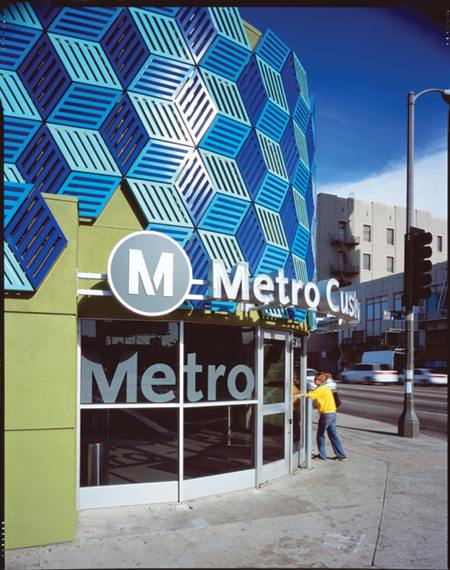
Untitled (Tilfords)
2006
Jim Iserman
459 powder coated aluminum panels and steel uni-strut
20" x 20" x 3" each panel, overall approximately 14" x 125'
Photo: courtesy LA Metro
JIM ISERMANN
Moving
seamlessly between art and design, Jim Isermann enjoys a symbiotic
relationship with Palm Springs, drawing from its bright midcentury
sensibilities and imaging innovative ways to express its spirit and
aesthetics. Isermann, who lives in a 1962 Donald Wexler-designed
prefabricated steel house with a collection of 1950s and '60s furniture,
was reaching back into West Coast modernism long before the Palm
Springs architecture and design renaissance made it cool again. His
early work was mostly abstract, sometimes functional and always handmade
with minimalist simplicity, Bauhaus craftsmanship and utility, and Pop
Art's mass-production ethos.
Colorful and sometimes-futuristic
precision patterns and algorithmic arrangements permeate his
labor-intensive work in a variety of media--from vinyl decals to
paintings to vacuum-formed ABS plastic panels that comprise
site-specific installations such as the facades of LA Eyeworks, SITE
Santa Fe and a pedestrian ramp wall at Cowboys Stadium in Arlington,
Texas.
Isermann is among a group of artists--including Jorge
Pardo, Andrea Zittel and Pae White--whose work boldly and unabashedly
intersects with design. None of the artists has suffered for it.
Isermann has a deep exhibition history with Corvi-Mora in London and
Richard Telles Fine Art in Los Angeles. In the past few years, he has
also signed on with Mary Boone in New York and Galerie Praz-Delavallade,
the Paris dealer that dedicated its 2010 Art Basel Miami Beach booth to
his meticulous, hard-edge paintings, furnishings and wall decals.
The
installation was a reminder of his 1998-99 traveling retrospective,
"Fifteen: Jim Isermann," and 2002 UCLA Hammer Museum exhibition. The
retrospective showcased his mastery of many mediums, and the Hammer show
punctuated the power of his algorithmically designed vinyl decals in
mural-size scale.
Isermann, an art faculty member at UC
Riverside, is active in the robust Palm Springs architecture, design and
preservation community. In 2006, he installed a site-specific
vacuum-formed styrene wall sculpture for Palm Springs Art Museum, where
he was featured two years earlier in the "Trespassing: Houses x Artists"
exhibition organized by Bellevue Art Museum in Washington that also
traveled to MAK Center for Art and Architecture in Los Angeles.
Abandoned Trailer, Bombay Beach, CA 2000
Kim Stringfellow
Lightjet Digital C-print
38" x 30 1/2"
KIM STRINGFELLOW
Many
artists depict the beleaguered Salton Sea as a post-apocalypse murk, a
failure of environmental management and a mounting threat to the quality
of life in the resort communities of Palm Springs. Their photographs
and paintings--and even their interventions and performances--might
exude a certain beauty and raise a measure of curiosity among people who
see them, but they typically stop short of actually educating. Not so
with artist Kim Stringfellow, who teaches photography and multimedia at
San Diego State University--including a course called Art, Environment
and Place. Stringfellow uses the field research strategies of
scientists, the reporting techniques of journalists and the venues of
traditional artists to tell an investigative and wildly visual story of
the Salton Sea as well as the proliferation of abandoned jackrabbit
homestead properties due north in the High Desert town of Wonder Valley.
Stringfellow's best-known image, Abandoned Trailer, Bombay Beach, CA
2000 which she included in a compelling exhibition at Michael Dawson
Gallery, shows an oxidized, encrusted metal shell of a trailer sunken
into a pool of liquid rust and salty grime. The orange-colored water,
polluted by industrial and agricultural runoff, set against a hint of
healthy green foliage and the clear blue sky underscores the
catastrophe. The image also appears on the cover of her book, "Greetings
From the Salton Sea: Folly and Intervention in the Southern California
Landscape, 1905-2005."
Propelled by the photographs, the book
chronicles the sea from its creation to its heyday as a resort
destination to its disastrous life as an environmental boondoggle. She
took a similar approach to her second book, "Jackrabbit Homestead:
Tracing the Small Tract Act in the Southern California Landscape,
1938-2008," which traces the midcentury rush on the land in and near
Wonder Valley to its abandonment.
"The interest in the Western
heritage and very romanticized image of the landscape was huge in the
1950s and into the '60s," Stringfellow explains in an interview for
KCET's "Artbound." "People came out here with a romantic idea of what
this was going to be like. And some of those communities are still
established today. But a lot of these properties were left to just
slowly degrade into the desert and melt back into this really desolate
landscape."
Her images capture the rustic Bohemia that prevails
in the area--a spirit of place that still holds an air of romance and an
incredible sense of space where you can see for miles. The photographs
in both series use the melancholic allure of the remains--submerged
structures in the Salton Sea and derelict shacks on land with no
electricity or water--to instigate renewed interest in the next course
for these fragile landscapes.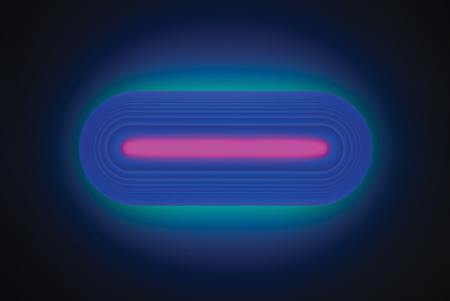
Lozenge 3
2012
Phillip K. Smith III
Acrylic, LED lighting
30" x 12 1/4" x 11"
Photo: courtesy Royale Projects, Palm Desert
PHILLIP K. SMITH III
LED lights pulsated with changing colors in Lozenge 1,
a pill-shaped, interior-lit translucent acrylic wall sculpture that
drew steady traffic at Royale Projects' booth at the inaugural Art
Platform Los Angeles in September. It signaled the arrival of the
gallery and one of its core artists, Phillip K. Smith III, whose
aesthetic--which takes cues from minimalist geometry, Bauhaus rigidity
and the possibilities of Light & Space--coexists with midcentury
modern-obsessed Palm Springs, located about 30 miles west of his Indio
studio.
"Every day, I find myself observing the desert--the
light, the colors, the forms, the shadows, the scale--and how all of
these elements change dramatically over the course of a single day," he
says. "Aperture and the following series of LED-lit acrylic works
[including Lozenge and Torus] could only have been
conceived in the desert. The purity of geometry, gradient of change and
the surface of shifting color are elements of my work that are desert
light inspired and that can hold up within the scale and texture of the
desert."
Smith was included in "Smooth Operations: Substance and
Surface in Southern California Art," the inaugural exhibition at the
Museum of Art and History in Lancaster. And he has gained much attention
in recent years for his large-scale public projects--including the
55-foot, glossy-red Fiberglas, steel and concrete "Inhale/Exhale" at
University of La Verne and the mirror-polished and powder-coated steel
"Where the Earth and the Sky Meet" in Oklahoma City. In the next 18
months, he'll install four large-scale public pieces in Palo Alto and
Walnut Creek in northern California, as well Nashville, TN, and
Arlington, VA.
"My architectural grounding helps in my public art
installations," says Smith, who holds degrees in fine art and
architecture from Rhode Island School of Design and worked for several
Boston architecture firms. "Architecture school taught me two things:
how to think through a problem, no matter what the discipline, and to
embrace new technologies. CNC milling and cutting, 3-D modeling
software, and Arduino coding are tools I use as readily as hand drawing
in my studio."
DESERT ARTISTS: ARIZONA
deborah ross
Three
Phoenix-based artists who have met with success over the years share a
commitment to living and working in the extreme climate that is the
Sonoran Desert. In fact, for all three, the arid landscape is integral
to their work: an iconoclastic use of scenic photography, in the case of
Mark Klett; remnants of desert life encased in resin, in the case of
Mayme Kratz; and commentary on encroachment into the desert, in the
earthworks of Matthew Moore. All three artists are represented in
exhibitions associated with the Desert Initiative (DI:D1) this year:
Klett and Kratz in "Desert Grasslands" at the Tucson Museum of Art and
Moore in a collaborative installation on copper mining, set for the
Arizona State University Art Museum.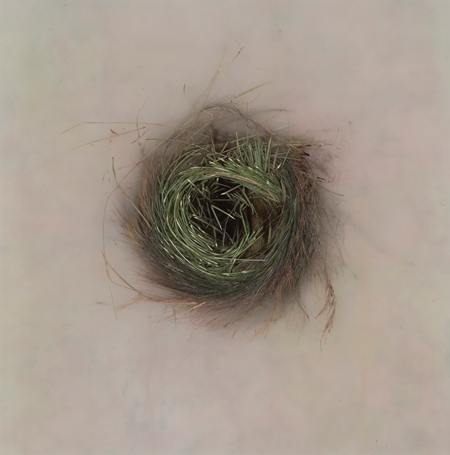
Knot 271
2012
Mayme Kratz
Resin, Arizona map and grass on panel
12" x 12"
Photo: courtesy Lisa Sette Gallery and Etherton Gallery
MAYME KRATZ
When
Mayme Kratz works, that could mean a number of things. The mixed-media
artist, who has resided in Arizona since 1986, likes to walk the trails
in the Phoenix Mountain Preserve and Superstition Mountains, which are
visible from her studio just south of downtown. But on any hike, her
eyes always wander to weeds, seeds, feathers, insect wings and other
remnants that others might consider detritus. She scoops them into her
sun hat or another container and, back in her studio, will examine her
collection under a microscope to study colors, textures, forms and
patterns. Quickly she envisions the reshaping of the materials into
cast-resin wall pieces or columns. In a days-long process, she
manipulates these revered objects from nature into precise patterns.
Then she suits up with protective clothing and eyewear to apply at least
a few coats of resin. Detail work with saws and sanders follows, until
the pieces radiate an unexpected, ethereal beauty. Even the tiniest of
objects reemerge as part of spirals, circles, crescents, ripples and
more. As far as Kratz is concerned, desert flora and fauna hold
limitless possibilities for reinterpretation in her works. The desert
climate is key, as the dryness helps preserve objects, while the
wide-open spaces offer more possibilities. Some of the more unusual
items that have made their way into her studio include a bobcat's spine,
wasp's gall, the mold of a brown pelican skull, rattlesnake ribs, and
cactus blooms. It's possible to stare at her work and not grasp the
materials she's used, as in a wall plaque bearing unrecognizable Mexican
bird of paradise seeds, carefully compacted into a brown wreath, or
when long shafts of wild grass turn into a thick mandala.
Part of
Kratz's aesthetic comes from her training and residencies, which
include an apprenticeship with James Hubbell and stints at the Pilchuck
Glass School and The Museum of Glass, both in Washington. She has
participated in solo and group exhibitions at the Scottsdale Museum of
Contemporary Art, the Tucson Museum of Art, and the Phoenix Art Museum.
The latter recently gave her a mid-career award and show.
Work
is inseparable from her life, Kratz says, noting how ideas spring to
life at unexpected times and in unexpected places. From a young age, she
says, she felt "a sense of destiny" about pursuing the kind of art that
she does, and the way in which she brings value to the infinite debris
of the natural world can't help but convey a spiritual resonance.
And The Land Grew Quiet
2012
Matthew Moore
Embossed paper, conveyors, ticker tape, pine, routed mdf, mixed media
5000 square foot installation at Phoenix Art Museum
MATTHEW MOORE
On
the one hand, Matthew Moore is a rising star in museum circles,
creating large earthworks as well as mixed-media installations that
raise questions about urban sprawl and sustainability. On he other hand,
Moore is a fourth-generation farmer, and probably the last in his
family to grow carrots and other crops on land just outside of Phoenix.
He struggles between the two worlds, but in the meantime remains
committed to living and working at Combine Studios, an affiliate of
Arizona State University in downtown Phoenix. In addition, he has been
tapped by ASU and Desert Initiative to curate "Feast on the Street,"
DI's culminating outdoor event in April 2013, in collaboration with
British artist Clare Patey, the force behind the annual "Feast on the
Bridge" in London. Moore, like Patey, is a vocal supporter of local food
sourcing, and to further the cause, Moore has created the Digital Farm
Collective, a nonprofit online hub for bringing together farmers and
educators. That's not all: Moore and Patey are collaborating on "CU 29:
Mining for You," a visual and tactile experience heightening awareness
about copper--its origins, uses and expendability--in light of copper
mining being one of Arizona's top industries. The show opens at the ASU
Art Museum in February 2013.
Moore comes across as driven,
earnest and intellectual, seeing himself as part of a "historical
dialogue of displacement" in the conflict between agriculture and
suburbia. His soul-searching led to "Rotations: Single-Family Residence"
and "Rotations: Moore Estates," in which he hand-hoed and dug the floor
plan of a home and, later, a one-third-scale representation of a
tract-housing layout--the soon-to-be-developed fields on his land
serving as the "canvas." The effort is preserved in aerial photographs
and videos. A few years later, still bridging the worlds between art and
agriculture, Moore was part of an Armory Center for the Arts show in
Pasadena in which he created a site-specific sculpture that gave
visitors their own vegetable seedlings. By 2012, the response was
glowing to his one-man show at the Phoenix Art Museum. Called "And the
Land Grew Quiet," it juxtaposed Dust Bowl-era photos and writings beside
white walls embossed with housing development plans. Nearby, Moore
erected the skeletal framework of a house seemingly sinking into the
ground.
Altogether, his work speaks to tough questions about
legacies, progress and culture. Even if Moore's future lies away from
his native Arizona, his heart remains in the arable desert landscape
that not only feeds his art but also represents his roots.
Site of a dangerous leap, now overgrown
2008
Mark Klett
Pigment inkjet print
10 1/2" x 17 1/2" Edition of 25
Photo: courtesy Lisa Sette Gallery, Scottsdale
MARK KLETT
Mark
Klett is fascinated with iconic landscapes and the passage of
time--think scenes of Yosemite, the Grand Canyon, the Sonoran Desert.
And it's not just about the geological changes, but also the
interventions of humans and the resulting record of survey maps,
paintings and photographs. The way this esteemed Arizona photographer
and former geologist sees it, however, our visions of scenic wonders
could use a little more subjectivity and context. And so, for more than a
decade, he and his collaborators have created "rephotographic
panoramas"--digital ink prints sometimes as wide as 96 inches--that
piece together new photographs with archival materials to construct
fresh and thought-provoking scenes. For example, Klett's latest book,
"Reconstructing the View: The Grand Canyon Photographs of Mark Klett and
Byron Wolfe" (University of California Press), repurposes maps,
postcards, lithographs and B&W photographs dating back to the 19th
century and including works by Ansel Adams, Edward Weston, Thomas Moran
and others. Through precise placement of overlays and insets, the older
works are embedded into Klett's digital photos.
"Rephotography"
is a painstaking process that begins when Klett and his fellow travelers
load camping gear, laptop computers and photography equipment into his
faithful truck and spend days at a time in desert and mountain
wildernesses, in effect retracing the steps of earlier painters and
photographers. The aim is to find the same vantage points and lighting
conditions, even weather conditions. Once back in his Tempe
studio--which is within walking distance from his post as a photography
professor at Arizona State University--Klett and his collaborators sift
through their thousands of digital images and many archival materials. A
large-format printer commands attention in the studio, and Klett leaves
lots of floor, table and wall space for spreading out prints and maps
and projecting images from a custom-made stereo viewer. His desert-hardy
personality is evident in the array of sticks hanging vertically on the
walls, each stick decorated with found objects from campsites during
his various photographic forays.
An Arizonan since 1982, Klett
began making a name for himself in art photography in the '90s and has
since exhibited at the Center for Creative Photography in Tucson, the
Phoenix Art Museum, the National Museum of American Art, and the Los
Angeles County Museum of Art. He is currently on a yearlong sabbatical,
partially dedicated to a rephotography project studying historic photos
by Eliot Porter and others, taken before Glen Canyon in Utah and Arizona
was dammed and flooded to create Lake Powell--an issue that still
raises environmental concerns.
Klett relishes the fact that his
photographic works subvert the idea of pure landscape documentation and
instead pose challenging questions about land use, cultures and human
intervention over time. The earlier-day artists may be "unwilling
collaborators," he says, but the hope is that his new statements somehow
magnify those artists' original visions.
DESERT ARTISTS: NEVADA
cherie louise turner
The
high desert of Northern Nevada, where the big little city of Reno is
located, sits just east of the Sierra Nevada Mountains. Located nearby
is the second largest alpine lake in the world, Lake Tahoe. This desert,
its environment harsh and wind-whipped, provides a visual and audible
quietude and clarity where the imagination can roam free--it notably
encompasses the Black Rock Desert, home to Burning Man. It's a stage
ripe for artistic exploration. Below are two of the many artists who
have found such inspiration there. 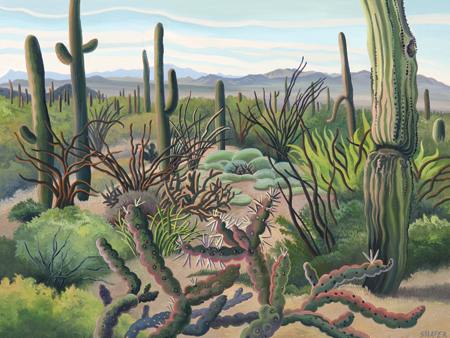
Winter Light
2009
Phyllis Shafer
Oil on panel
12" x 16"
Photo : Stremmel Gallery, Reno / Phyllis Shafer
PHYLLIS SHAFER
Landscape
painter Phyllis Shafer has long called South Lake Tahoe home, making
the vast Carson Valley and desert beyond regular areas of exploration.
Additionally, she has trained her brush on Arizona's Sonoran Desert.
Shafer paints lyrical, graceful work, replete with heightened patterns
and movement of the views she captures. The desert, says Shafter, "has
the rhythms I'm looking for," as well as the space and the solitude to
absorb the landscape, to become immersed in it. "I love the
uninterrupted openness," she says. "And, there's also something surreal
and strange about the desert." Shafter's saturated color and fluid lines
relay the otherworldliness of the place, and bring to life what others
may see as an empty wasteland. Her work will be the subject of two
upcoming shows: at the Nevada Museum of Art in January 2014, and at
Stremmel Gallery in Reno in October 2013.
Shafer points out that
in Arizona, it is the cacti that catch her attention, particularly the
saguaro. In her paintings of them, they seem like characters, animated
and in conversation with the surrounding flora, sky, and hills. In
Nevada, it's the ruggedness and low-lying plant life that she focuses
on. Her big, whirling skies further add to the playfulness of the
scenes. "For me, these paintings are a dance between what I see in
nature and the process of translating it." It is a process Shafer enjoys
taking her time with: "I love becoming intimately familiar with the
nature I paint," she states, by way of explaining her penchant for
capturing the views that immediately surround her. The landscape takes
on an allegorical life; "it's a symbol of our journey through life, a
self-reflection," she explains. "It's almost literary to me, symbolizing
something internal."
The desert as a subject then becomes not
just about seeing, but about revealing what is not immediately evident,
the richness in an environment that doesn't readily give up its secrets,
but where stories of life, hard fought and often hidden in the
vastness, abound. "I love to peel away the layers of landscape," says
Shafter. "And with the Nevada desert, I feel I've just begun to scratch
the surface." 
Umbrella and Black Rock
2002
Peter Goin
4 x 5 color negative, pigment print on Hahnamuhle watercolor 350 gsm paper, 20" x 25"
Photo: courtesy of Peter Goin; image from the book,
Black Rock published by the University of Nevada Press in 2005
PETER GOIN
For
Reno-based photographer Peter Goin, the surrounding Northern Nevada
desert has long been a focus. Among other notable bodies of work on the
subject are his photographs of the Black Rock Desert, published in the
aptly named book "Black Rock." When asked why he photographs the desert,
he simply replies, "The reasons are complex."
Immediately what
Goin addresses when untangling the complexity of his interest in the
desert is the inherent, unspoken spirituality of a place. He points out
that one of the first questions one should ask oneself when addressing
deserts is, why have most of the world's religions formed in arid,
desert areas? "When you are in the desert," Goin notes, "you might be
the only person for four hundred square miles; you tune into the distant
sounds, the subtlety of the air movement." He continues, "Out on the
Playa [the Black Rock], if you sit quietly enough, you can actually hear
your heartbeat; you can hear your blood flow; you can hear the whine of
your own electrical system." In short, the desert is a vehicle to
getting in touch with ourselves while also getting in touch with our own
insignificance. "There is a unique feeling of space and horizon. Our
identity becomes where we are: we don't define it; it defines us."
Goin
also addresses the art historical link to desert photography. "You can
see the desert in minimalism, and even to a certain degree in Abstract
Expressionism. Certainly in Rothko's paintings, whether he meant it or
not, you can find the desert: the horizon line, the haziness." But,
also, there is a definite dearth of images of Northern Nevada--a void
that Goin is working hard to fill.
In regards to this pursuit of
capturing the grandness, the vastness of this wide-open view, it is, he
notes, a constant challenge. "It takes a lifetime of viewing," he says.
There is the additional trouble of the harshness of the environment: it
can at times be physically impossible to make photographs, most
especially because of the wind, which fiercely tosses dust and sand. But
for Goin, capturing this sacred place, a place linked to origin stories
and where one is compelled to contemplate the very questions of
existence, is a calling. "I don't own the land," states Goin. "The land
owns me."
MEL RAMOS
American Pop Art pioneer receives Lifetime Achievement Award at the Palm Springs Fine Art Fair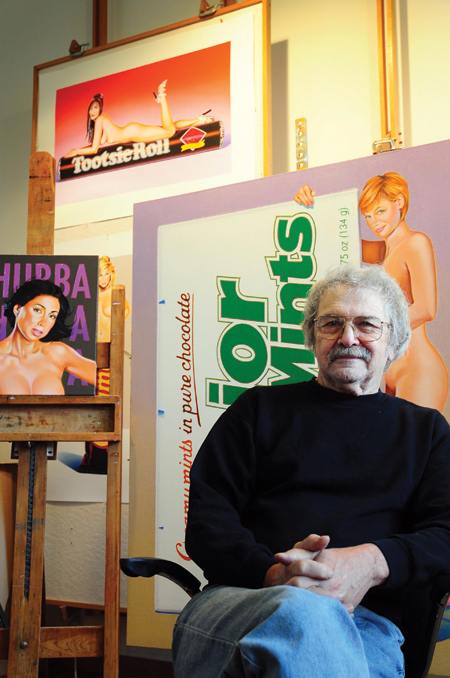
Fueled
by a childhood fascination, Pop artist Mel Ramos is best known for his
paintings of comic book heroes and sexually charged Americanized pin-up
style nudes interacting with imagery drawn from a broad lexicon of
popular culture. Ramos' unique approach to art, and his deep connection
to the Pacific Coast, can be traced back to the sixties, when he
utilized his
illustration skills in a graphite drawing depicting a
shark attack in a situation where the top-most diver appears to be
winning the battle against one of man's most feared enemies. Although
their work differed greatly, California-bred Ramos was mentored by his
comrade and fellow West Coast Pop artist Wayne Thiebaud. Other
influences include Roy Lichtenstein; Andy Warhol; and his life long
friend, Tom Wesselmann--an artist who is also known for the sensuality
of his POP culture-derived work; as well as the renowned pin-up girl
illustrator Alberto Vargas. Unlike Vargas, whose models were often set
against ambiguous white back drops, Ramos' approach to the often erotic
subject matter purposefully flirts with the kitsch, juxtaposing female
nudes with oversized candy bars, soda bottles, and other often-edible
products. The timing of his work contributed to the
rebirth of the idealized nude.
The
famed artist, now 77, is widely considered one of the pioneers of the
1960s American Pop Movement. The spectrum of his career was recently the
subject of a retrospective exhibition, titled Mel Ramos: 50 years of
Superheroes, Nudes, and Other Pop Delights, at the Crocker Art Museum in
Sacramento. Ramos will be the recipient of a Lifetime Achievement
Award, which he will receive at the Palm Springs Fine Art Fair in
February of 2013. Concurrently showing at the fair, Mel Ramos: Pop Icon
"The First 50 Years" debuts at the fair February 14.
Mel Ramos'
work is included in the permanent collections of the Whitney Museum of
American Art, the Guggenheim Museum, Museum of Modern Art in New York,
the San Francisco Museum of Modern Art, as well as the Corcoran Gallery
of Art, the National Gallery and the Smithsonian Institute in Washington
DC, among others.
To download a pdf of the 2013 DESERT PS SUPPLEMENT.pdf, please click here.